

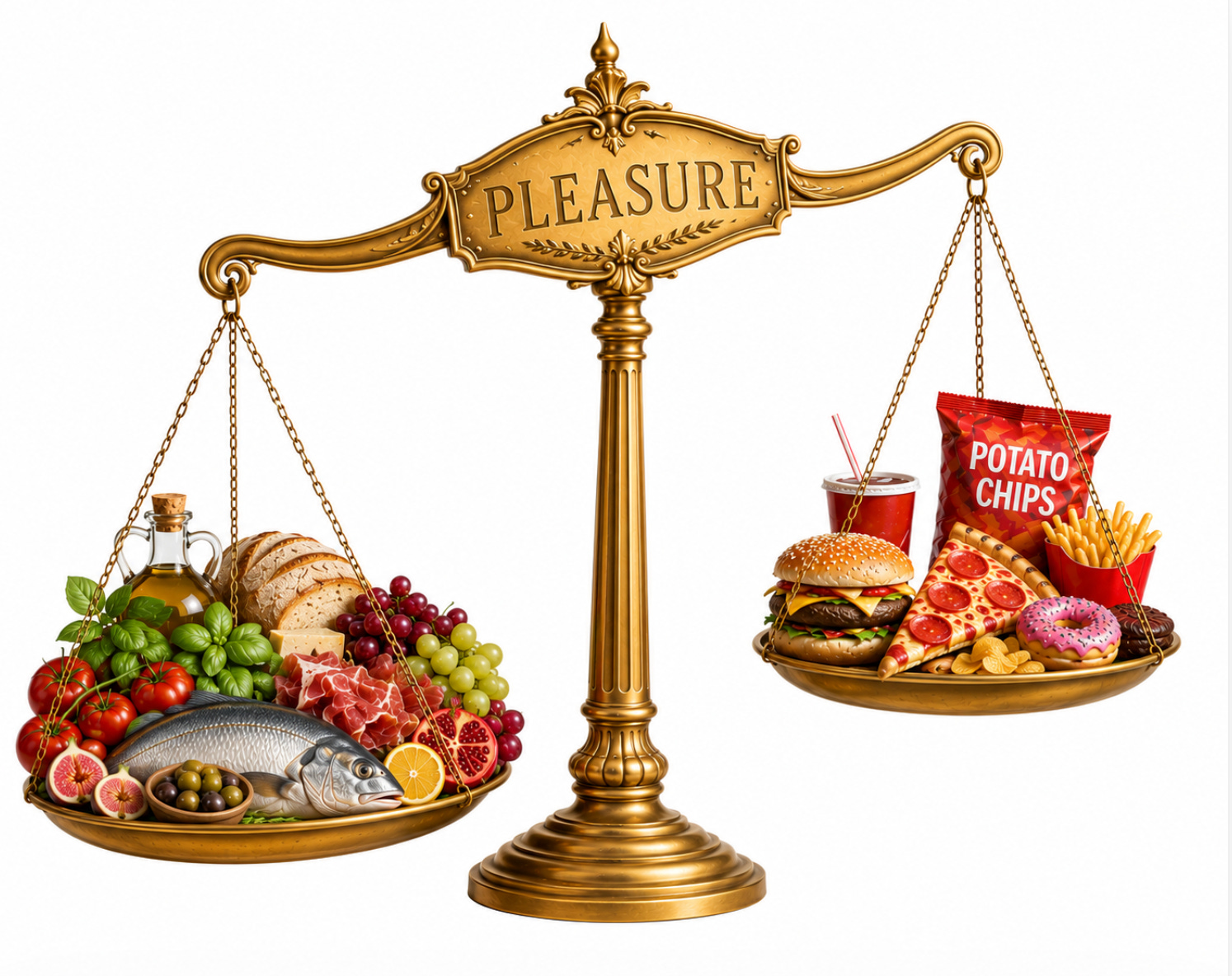
There is a widespread belief that the obesity epidemic is driven by a food environment that overwhelms us with deliciousness. Ultra-processed foods, the thinking goes, are engineered to be so demonically “hyperpalatable,” we can’t resist the intense pleasure they deliver.
Anyone who has read any of my books will know I don’t subscribe to this view. In The End of Craving, I pointed out some of the more obvious problems with this theory. Consider Italy. Italians enjoy arguably the best cuisine in the Western world. If delicious food caused obesity, then Italy should have one of the highest rates of obesity. Instead, it has one of the lowest. Japan and South Korea are similar examples of cultures that eat extraordinarily good food yet maintain remarkably low rates of obesity.
Scientific research is pointing towards at the same conclusion. My friend and colleague Dana Small, along with her PhD student Justin Sung, recently published an article in PLOS Biology furthering the case that pleasure is not the problem. Here are some of their most compelling points.
You may remember Kevin Hall’s landmark 2019 paper on ultra-processed foods—the experiment that Jeff Brunstrom, I, and several colleagues reanalyzed earlier this year. In the study, 20 adults spent two weeks eating an ultra-processed diet and two weeks eating an unprocessed diet in a tightly controlled metabolic ward. The headline finding was striking: participants ate about 500 more calories per day when they were served the ultra-processed meals.
Dana and Justin point out one of the experiment’s overlooked details: the participants found both meal types to be equally pleasant. The ultra-processed menu—featuring foods such as hot dogs, quesadillas, and chicken nuggets—did not deliver any more pleasure than the unprocessed menu that included spinach salad, rice pilaf, and broccoli. Whatever drove people to eat more ultra-processed calories, it wasn’t the way it tasted.
They also describe the intriguing case of “sweet likers”—people who derive unusually strong pleasure from sweetness and often prefer sugar concentrations that others find excessive. It’s easy to imagine that these sugar indulgers would be heavier. After all, if pleasure drives overeating, those who enjoy sweetness the most should be at greatest risk of consuming excessive amounts of sugary foods.
But that isn’t what the data show. The characteristic that most clearly distinguishes sweet likers is not higher body fat but greater fat-free mass—muscle, organs, and bone.
This seems puzzling. It makes more sense when you realize that fat-free mass is the primary determinant of resting energy expenditure—the fuel your body burns simply to stay alive. Perhaps those sweet likers like sweetness because their energy-hungry bodies require the energy sweetness delivers.
Lastly, there is the remarkable success of GLP-1 drugs. Just a few years ago, the degree of weight loss they now routinely produce seemed biologically impossible. Do these drugs cause people to eat less by reducing the pleasure delivered by food?
A group of scientists in Geneva, Switzerland, tested this by putting 66 patients on the GLP-1 drug liraglutide or a placebo. During the course of treatment, they were asked to rate the pleasantness of a chocolate milkshake as their brains were scanned. The subjects receiving liraglutide lost weight, but their reported liking of the milkshake held steady, and so did their brain responses. As the authors dryly summarized, “this study suggests that liraglutide leads to weight loss but does not provide evidence that it is due to a change in food-related liking in participants with obesity.”
The evidence keeps pointing in the same direction: delicious isn’t the villain. Across cultures, clinical trials, psychological studies, and obesity treatments, greater enjoyment of food does not lead to more body fat. People can love food and remain lean, and they can lose weight without liking food any less.
Pleasure is not the force overriding our biology. Pleasure is the tool evolution created to guide us toward what we need. The mystery of obesity is not why food tastes too good. The mystery is why so many bodies still seem to be searching for something that all that food cannot deliver.
***
Mark Schatzker is the Writer in Residence and Associate Director of Communications at the Modern Diet and Physiology Research Centre (MDPRC), McGill University.