

IF THE LAST THIRTY YEARS of diet mania could be boiled down to a single question, it would be one that, by this point, has become tired and irritating yet will go not away. That question is:
Carbs or fat?
Fat was the undisputed nutritional villain in the 70s and 80s. We lived in fear of steak, butter and eggs until we decided that, actually, it was all carbs’ fault, whereupon we launched a series of crusades against pasta, bread, wheat, sugar and potatoes. If more recent trends like carnivore or vegan keto are anything to go by, the anti-carb era hasn’t ended.
The rate of obesity incidence, of course, wasn’t paying attention. No matter what we eat or try to not eat, our collective BMI keeps ticking steadily upwards. All of which would seem to suggest we’ve been getting it all wrong for an awfully long time.
But what if the truth lies somewhere in between? What if we were half right about carbs but also half right about fat? What if the nutritional bad guy conspiring to make people overeat isn’t carbs or fat but the tag-team combination of both carbs and fat.
If you have yet to hear about the fat+carbs story, I predict you will. This original and surprisingly simple idea has given rise to a growing body of scientific research that is not only challenging our understanding of how humans value food, it is also painting an amazingly detailed portrait of how the brain senses and prioritizes these two crucial yet controversial nutrients.
So Happy Together
The story begins in 2015 at, of all places, a ski resort in Vancouver, British Columbia. Neuroscientist Dana Small was attending a lecture on sweet taste when she began thinking about carbs and fat. In popular culture, the two nutrients are seen almost as opposites—one good and one bad, depending on ideology. In Small’s world, however, scientists tend to conflate the two, often seeing them as interchangeable sources of what really matters: calories. Small envisioned them in a new light, not as opposite or interchangeable, but in combination. If carbs and fat each triggers its own distinct reward response in the brain, she thought, what happens when they are both activated at the same time?
Three months after that carb-fat moment, Small and her post doc, Alexandra Difeliceantonio, found themselves in the lab of German neuroscientist Marc Tittgemeyer, at the Max Planck Institute in Cologne, Germany, putting the idea to the test.
The experiment used what is known as an auction task, which gauges people’s willingness to pay for something. Fifty-six participants were given 5 euros and loaded into the brain scanner, inside which they were asked to bid on images of familiar snacks. Some snacks, like cheese, had most of their calories coming from fat; others, like a lollipop, were primarily carbohydrate; and others, such as a pastry, were a blend of both. All the snacks packed a similar hit of calories. All the while, the MRI machine scanned their brains.
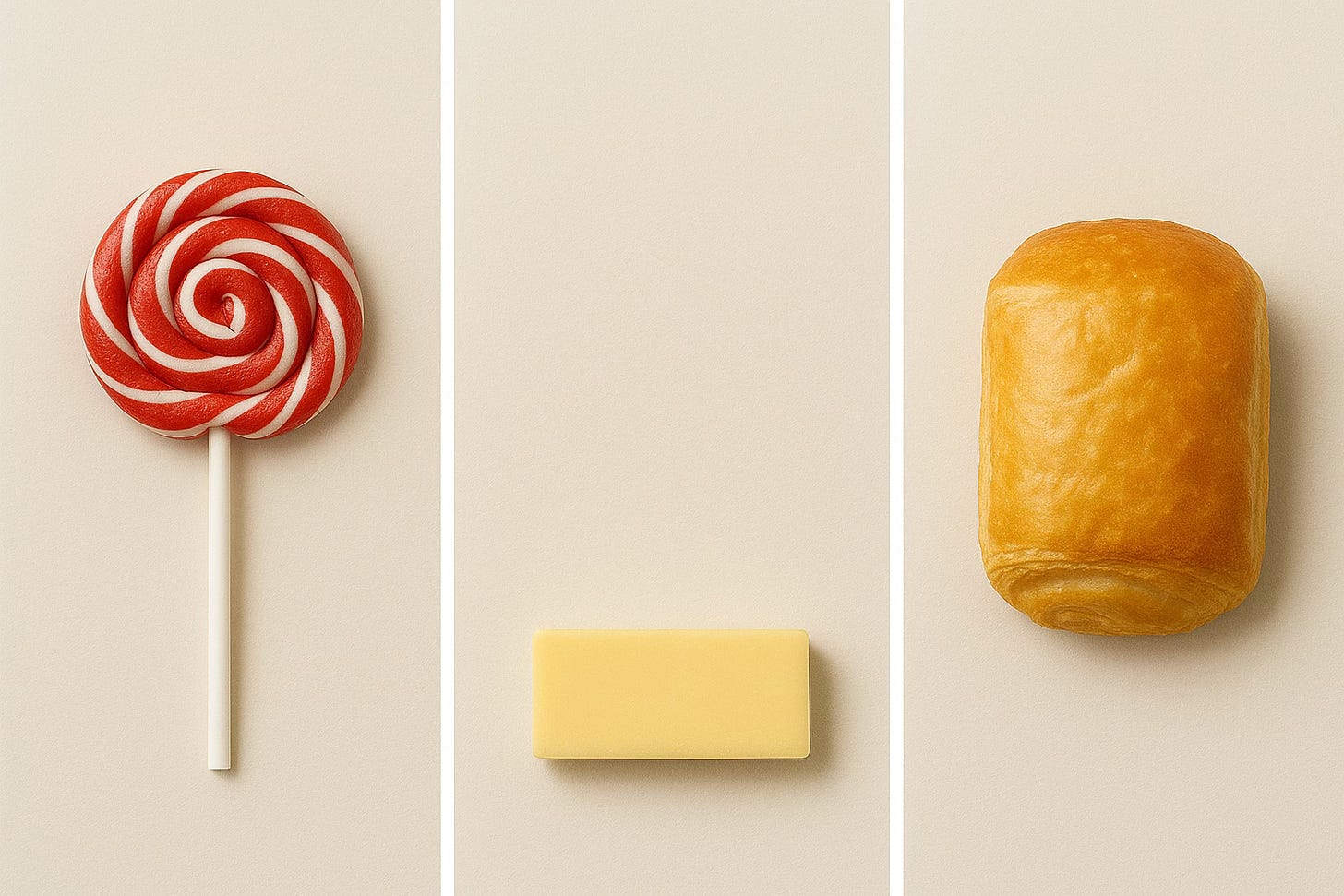
As Small and her colleagues predicted, there was something unusual going on with fat+carbs. The subjects rated all of the snacks as being equally well liked. Lollipop, salted pretzel, cheese, pastry—all similarly delectable. Despite that, they bid more for the fat+carb snacks. Also, the brain “reward” response per calorie was greater when bidding for the fat+carb snacks. The effect was “supra-additive,” meaning that somehow combining fat and carbs created a reward response whose sum was greater than the payload of calories would predict.
It’s What Happens After You Swallow That Counts
For Small, the phenomenon comes down to the “post-ingestive” effects of food. Post-ingestive is science-speak for “after-you swallow”, and this is how it works.
As anyone who’s ever eaten a meal can attest, we sense food as we eat it. We see it, we smell it, then we savour its taste and flavour. Most people think that’s where the sensing aspect of food ends—at the throat—at which point the chewed-up wad of food tumbles into the stomach where the serious work of digestion begins.
In truth, the mouth is more like the end of the beginning. The brain continues to sense food long after it’s swallowed. And even though we don’t consciously experience this after-you-swallow sensing, it is more important than the sensing we do experience, as odd as that may sound. It is during this after-you-swallow phase of sensing that the brain tracks the nutritional content of food and assigns it a value. In more simple terms, the brain is asking what did I get and is it any use to me?
Consider the following experiment: There are two bowls of vanilla sorbet. To one bowl, a flavourless carbohydrate called maltodextrin is added, which boosts the calorie count but leaves the taste unchanged. To the other bowl, the zero-calorie sweetener called sucralose is added, which amps up the sweetness without raising calories. Thanks to post-ingestive sensing, the brain learns which sorbet packs the biggest caloric punch. This leads to something odd: In experiments, subjects will say they prefer the taste of the sweeter sorbet yet they will eat more of the blander, higher-calorie sorbet. Such is the intelligence of the nutritionally-wise brain.
How does the brain track calories? Scientists have long known there are dedicated fat and carbohydrate sensors in the gut, but what was less clear is how that signal is conveyed to the brain. Last year, the journal Cell Metabolism published a study that traced the gut-to-brain sensing of calories in the most minute detail, while also testing the fat+carbs hypothesis in mice.
This study was, to say the least, complicated, taking five years to complete and comprising nearly the entire PhD work of its lead author, Molly McDougle. A typical sentence reads as follows: “FosTRAP mice received bilateral NG injection of the Cre-inducible viral construct AAV9- EF1a-DIO-hChR2 (H134R)-EYFP (ChR2) to selectively express the light-sensitive depolarizing channel channelrhodopsin-2 (ChR2) in vagal sensory neurons.” (Say that ten times fast!)
To describe this investigation in its entirety would take up the better part of a very dense book (with little in the way of plot). But examining how these scientists studied a single piece of mouse anatomy gives a flavour of the extraordinary intricacy of modern science.
The vagus nerve stretches from the brainstem down to the large intestine, and is a busy and important nerve indeed. Besides being involved in taste, urination, mood, blood pressure, breathing and heart rate, it also conveys signals from fat and glucose sensors in the gut up to the brain. McDougle and colleagues wanted to know just how that information is carried. If you imagine the vagus nerve as a bundle of wires, is there a single wire that carries the fat and glucose signal, which the brain interprets as “energy”? Or are there separate wires for fat signalling and glucose signalling so that the brain can discern one from the other?
To find out, the team used an extremely precise “two-photon” microscope to zoom in on a tiny stretch of vagus nerve where it passes over a mouse’s throat so they could watch it convey information live. They then infused either fat or sugar into the mouse’s gut and waited to see what happened: Some neurons fired for fat and other neurons fired for sugar. Very few, however, fired for both, thus demonstrating that the brain receives a different signal for fat than it does for sugar.
That signal, importantly, doesn’t end where the vagus nerve ends. The signals for each nutrient remain distinct until they are conveyed to the brain’s reward centre, where they each trigger distinct patches of grey matter.
To round out the study, McDougle and her team let the mice do the talking, so to speak. They gave the mice access to three spouts. One contained sugar-water, one contained fat-water, and one contained sugar+fat-water. (All three liquids were equally calorie-dense.) With the fat- and sugar-water, the mice licked at an equal rate. But when given sugar+fat-water, with both pleasure circuits engaged, they licked at double the speed.
Lastly, McDougle and co. did something sneaky yet illuminating. They gave mice flavoured liquids to drink while surreptitiously pumping sugar, fat or sugar+fat into their stomachs. With time, the mice learned which flavour was matched to the sugar+fat combo and, once again, the mice cranked up the rate of licking—even though the mice couldn’t actually taste the sugar and fat.
It was all post-ingestive. The nutrients were sensed, the information was conveyed to the brain, and the brain responded by licking more vigorously, thus demonstrating the power of fat+carbs to accelerate intake and that this boost in intake can be completely unrelated to the pleasure of eating.
Is This Driving Obesity?
And now back to our central, urgent question: Does the hyper-rewarding nature of carbs blended with fat play a role in the epidemic of obesity? Are the two nutritional villains of the past half century co-conspirators that have been quietly goading us all into eating too much?
The theory has a lot going for it. For one thing, it feels right. Imagine eating a plain slice of white bread—blah. Imagine eating a cold wad of butter—again blah. Now imagine spreading that cold wad of butter over the bread and then eating it—yeah! Perform this same thought exercise with fettuccine and alfredo sauce, or hotdogs and buns, or pizza crust and cheese. Picture a carb, any cab—rice, noodles, baguette, couscous, potatoes—and it cries out to be smothered in fat. Everywhere you look, you see blends of carbs and fat.
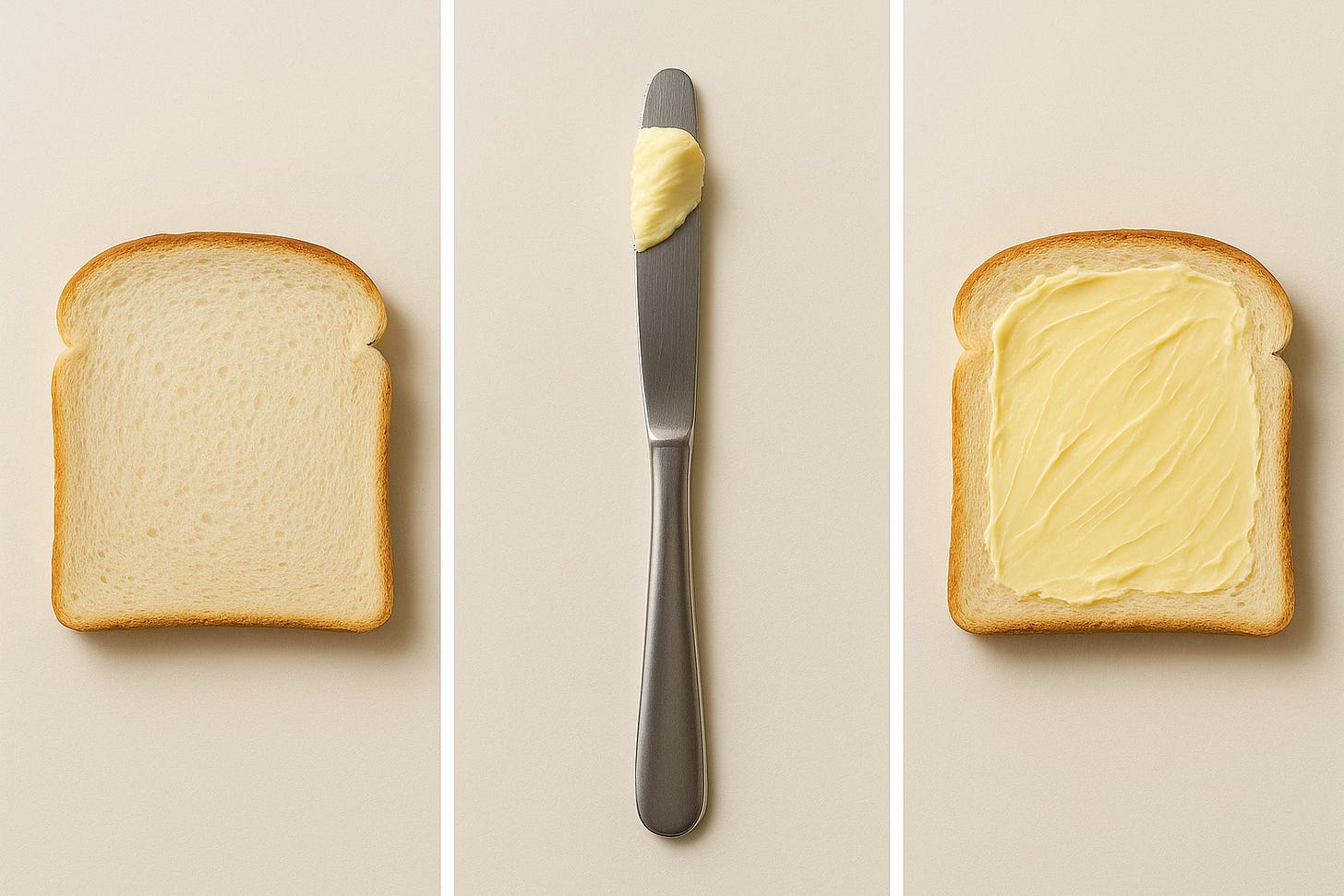
Except, that is, in nature, where blends of carbs and fat are especially rare. The big exception is breast milk, which means we may be pre-ordained to mindlessly consume foods that approximate a similar fat-carb ratio to that which we experienced as suckling infants.
Then there’s this: Low-fat diets work. So do low-carb diets. So long as you stick to them. The implicit lesson seems to be you can eat fat or you can eat carbs, but not both.
The most unsettling aspect of the fat+carbs effect is the unconscious grip it has on eating. Dana Small’s subject’s brains lit up more for fat+carbs. Molly McDougle’s mice licked harder for fat+carbs calories they couldn’t even taste. It happens to us all. If you’ve ever found yourself reaching for yet another cold, greasy French fry, you too have experienced the power fat+carbs has to make you eat food you don’t enjoy.
Given all of the above, it seems almost obvious that the supra-additive effect of carbs blended with fat is contributing to the epidemic of obesity. Not surprisingly, Dana Small put this theory to the test, too. She repeated the auction task, but this time half of the subjects were overweight or obese.
And there was no effect. I repeat: No Effect. Zero. As in the previous study, healthy-weight subjects were more turned on by images of foods containing fat+carbs. The subjects with overweight or obesity, on the other hand, didn’t seem to care. Fat or carbs or fat+carbs—they valued all calories equally.
Could Fat+Carbs…Be Good?
So let’s take a different approach. If blending fat and carbs isn’t hurting us, could it in some way be helping us?
A team of scientists at the University of Bristol recently conducted their own experiment and, like Small, they found that subjects gave higher ratings to fat+carb combinations. But they took a different view of what may be going on.
In a paper in the journal Appetite, they point out that the goal of eating is to consume enough nutrients before becoming sated. This is of particular importance for humans who, compared to their hominid ancestors, have a large brain and small digestive tract, and thus require a more energy-dense diet. The more efficiently our ancestors could acquire calories, the more time they had to hunt, gather, build structures, make tools, fight off rivals or engage in other fitness-promoting behaviour.
But this evolutionary requirement for dense bursts of calories presents a problem of its own. Concentrated doses of fat or carbs on their own are hard on the gut. If you don’t believe me, try eating a bowl of sugar or glugging down a mug of vegetable oil. The revulsion you feel is the wisdom of the body—your brain knows this is a bad idea.
Blending carbs with fat, however, gets around this problem. As the Bristol paper put it, the “digestive, metabolic, and absorptive capacity of the gut may be less readily swamped (overwhelmed) by a meal comprising equal calorie amounts of carbohydrate and fat.” Put more simply, mixing carbs and fat lets you eat more calories without stressing your gut.
What if the preference for carbs paired with fat represents a form of nutritional intelligence? Instead of a weakness in our evolutionary design, perhaps it is a strength?
This theory also has its strong points. Adding fat to carbohydrates lowers the glycemic load. We use different micronutrients to metabolize carbohydrates and fat, so perhaps in an evolutionary environment in which micronutrients could be scarce, it made more sense to consume both.
And while fat and carbohydrates are both forms of energy, they have important differences. Carbs are the body’s preferred energy source for immediate, high-output activity, like sprinting. The problem is storage space (glycogen, in the liver and muscles)—there isn’t much. If you want to hammer the pedal down, you burn carbs. But you only have so much.
Fats, on the other hand, have a vastly larger storage capacity, but are used for lower-impact activity. Given that each fuel has its advantages and disadvantages, perhaps we are better off having a bit of both rather than just one.
And then there’s this: the epidemic of obesity took flight in the 1970s whereas pairing carbs with fat goes way, way back. The Ideal Cook Book, published in 1889, has recipes for potato salad (potatoes, olive oil), escaloped potato (potato, crumbled crackers, butter, sweet cream), muffins (flour, milk, egg, “butter the size of a walnut”), waffles (flour, butter, eggs) and “doughnuts” (sugar, milk, eggs, butter), among many others.

The English Hus-Wife, published in 1615, features a recipe for “panperdy”, which comes from the French “pain perdu” and which you make by soaking bread in egg yolks and then frying it. (French toast, in other words.) The Ancient Roman cookbook attributed to Apicius has a recipe for deep-fried honey fritters that calls for goat’s milk, olive oil, white flour, wholemeal flour, more olive oil, and honey.
You get the idea.
It Makes No Sense!… Or Does It?
So let’s just add up some of the evidence:
-
People bid more for blends of fat+carbs than for foods of equal calories that are mainly carbs or fat
-
Carbs and fat are each sensed by dedicated sensors in the gut
-
Each nutrient sends a distinct signal, which is preserved as it reaches the brain’s reward centre, where each triggers a distinct reward response
-
Blends of fat+carbs thus light up the reward centre more than carbs or fat alone—in both mice and humans
-
Mice lick faster for blends of fat+carbs
-
Mice lick faster for a blend of fat+carbs even if they can’t taste it
-
Blending fat+carbs may be an evolutionarily beneficial mechanism of packing in more calories while reducing stress on the gut
-
Blending fat+carbs may be more metabolically optimal than consuming just carbs or fat
-
But blending fat+carbs was commonplace long before the epidemic of obesity took hold
-
People with obesity, nevertheless, do not value blends of fat+carbs more than carbs or fat. They seem to value all calories equally.
It doesn’t quite add up, does it? Blending carbs and fat sometimes looks bad but sometimes looks good. Welcome to the cutting edge of scientific research, where with each new discovery the picture keeps getting clearer and muddier all at the same time.
So let’s take yet another approach: What if fat+carbs preference can be both a feature and a bug. What if the real problem is…ultraprocessed foods?
Let’s go back to those cookbooks for a second. If you flip through any one of them, new or ancient, you will find recipes that combine fat and carbs. But you will also find many that do not (e.g. jam on toast). If you take a survey of ultraprocessed foods, on the other hand, you find fat+carbs everywhere.
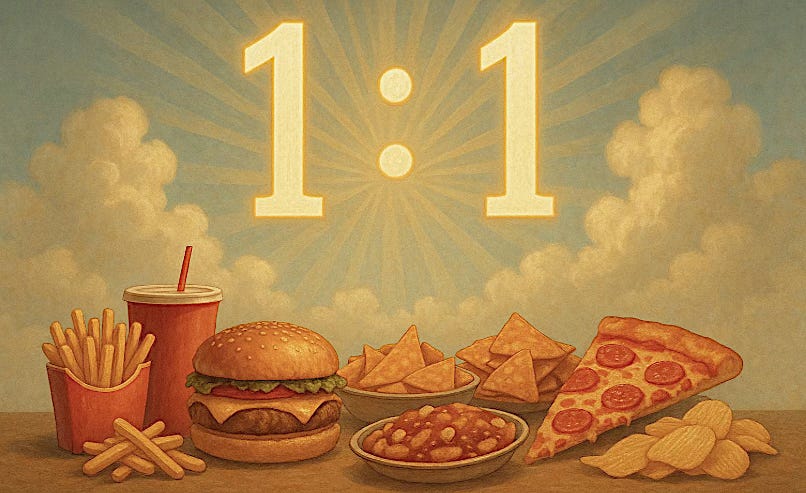
A Big Mac has a fat-to-carbohydrate ratio of 1.7:1. But when combined with French fries and a medium Coke, the three together strike a brain-motivating balance of 0.8:1. And this optimal ratio—hovering close to 1:1—is just how it looks for other celebrities of the ultraprocessed world:
Doritos: 1:1
Pringles: 1.3:1
Poutine: 1:1
Pizza Hut Pizza Rollers: 0.8:1
KFC Double Down: 1:1
Just try and find an ultraprocessed food that isn’t a near ideal blend of carbs and fat. It isn’t easy. I’ve tried.
So perhaps the truth is that our preferences for fat+carbs is both a feature of an intelligent appetite, but also a weakness. For eons, our predilection to blend these two nutrients optimized the act of eating and helped us nourish ourselves efficiently and effectively. The modern food environment, however, has become a kind of strange nutritional prison, where pre-made, near-perfect combinations of fat and carbs are in every bite.
Whether we like it or not.
***
Mark Schatzker is the Writer in Residence and Associate Director of Communications at the Modern Diet and Physiology Research Centre (MDPRC), McGill University.
Follow me on X and Instagram: @MarkSchatzker