

Imagine the same race, except in this version the hare does not take a nap. He sprints from start to finish and thrashes the tortoise so utterly that you can’t even really call it a race.
Not even this allegory, I’m afraid, is stark enough to describe the contrast between two meetings I would like to tell you about. Both took place in Chicago this past summer, and both are highly relevant to the raging issues of: body weight, health, longevity, disease, happiness and everything else connected to the now deadly act of eating.
The first was the annual meeting of the Society for the Study of Ingestive Behavior (SSIB). The second was the annual meeting of the Institute of Food Technologists—“the world’s leading food technology event”—which is called IFT:First.
The timing was striking. The world is in a state of grave concern over ultraprocessed foods and here, in the same city, were two meetings confronting this very subject. One meeting featured the scientists who study ultraprocessed foods. The other featured the companies that make ultraprocessed foods.
I visited both.
That’s not quite accurate. I attempted to visit IFT:First but I only had a single day, and trying to take in IFT:First in one day is like trying to watch all 782 episodes of The Simpsons over lunch. I caught, at best, a glimpse.
And, may I say, what a glimpse. Imagine a very large trade show. Double it. Double it again. IFT:First takes up stupendous 216,778 square feet—five acres of men and women by the thousands in business casual, lanyards draped around their necks, walking a carpeted grid of gleaming exhibits.
There is a crackling sense of anticipation, as though at any point the music might start or an A-list celebrity will take the stage. As you move through the crowd, you overhear disconnected morsels of conversation.
“Hibiscus flavour, but no hibiscus!”
“Shawn, do we want to keep this branding visible?”
“Probably forty or eighty drums per month.”
As with oceans and other large bodies of water, it is impossible to see clear across from one side of IFT:First to the other. This thing is huge.
There is an organic pavilion. There is a stage. There is an innovation lab, a poster area, a start up pavilion, several networking lounges, an area for “fireside chats,” as well as a theatre where the really big talks are held.
The air of technology hangs thick. The poster area features more than 425 glossy billboards displaying exciting new findings including:
“Development of Whey Protein Hydrolysate (WPH)-Epigallocatechin-3-Gallate (EGCG) Conjugates to Enhance Calcium Binding Capacity and Emulsifying Properties”
“Exploring the Process and Formulation Dependency of Extruded High Moisture Meat Analog Texture and Chemistry”
“Antimicrobial Effectiveness of Iron-Doped ZIF-8 (Fe-ZIF-8) Nanoparticles Internalized Into Spinach and Lettuce Plants”
Springer, the academic publishing house, has set out a mini library of books, whose titles include: The Age of Clean Label Foods, Sustainable Global Resources of Seaweeds: Volumes 1 and 2 and Application of Nanotechnology in Food Science, Processing and Packaging.
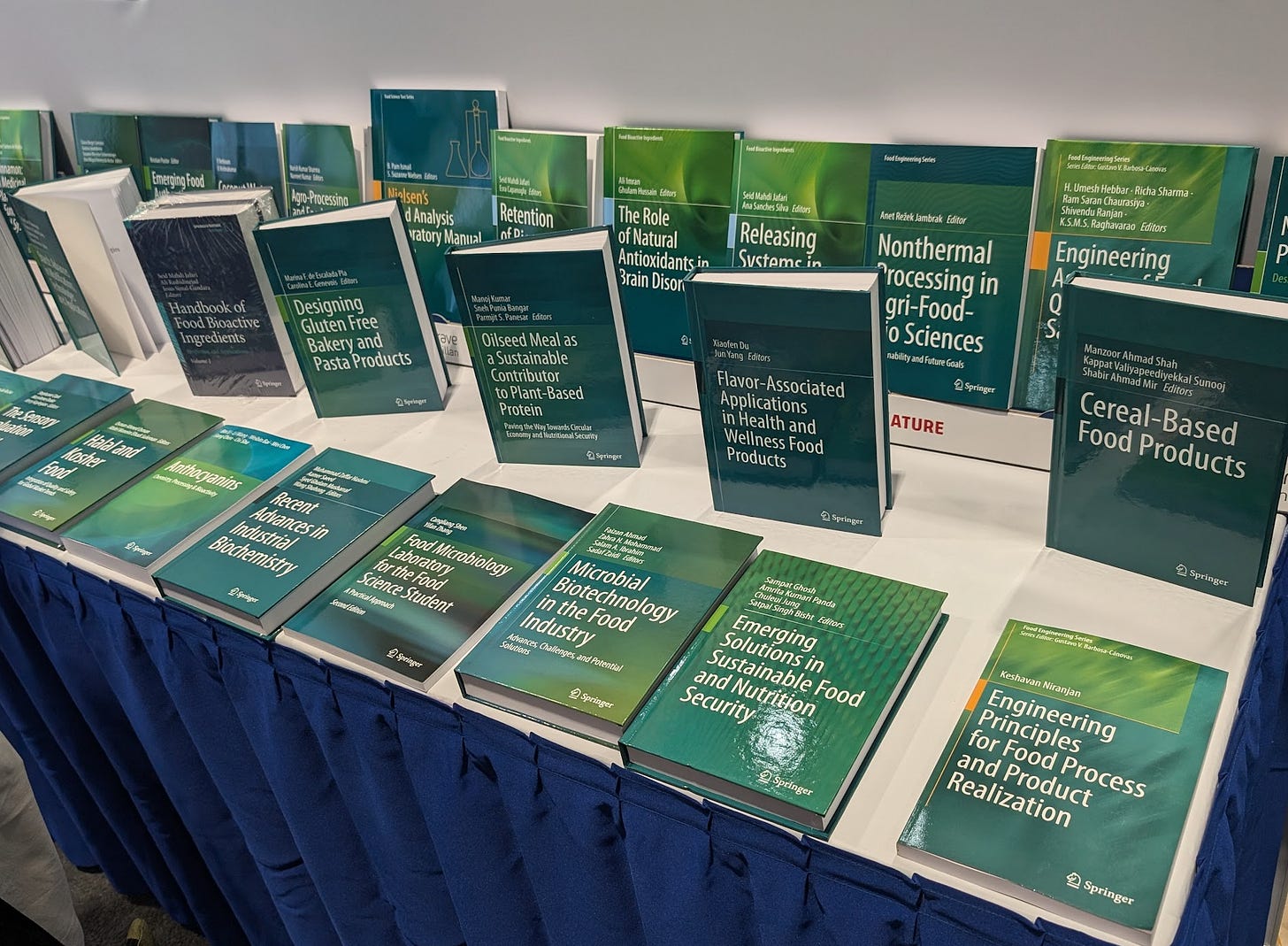
But mainly, there are exhibits, 1,134 of them, bright and polished. The bigger companies—Ingredion, DSM Fermenich, AAK, ICL, Samyang, Primaria, Caldic, Revela, Hilmar, etc—pay extra for elaborate signage that hangs from the ceiling like a crown. A perfect red ring sits overtop Givaudan, the world’s largest flavor and fragrance company, that says simply, “Givaudan sense colour.”
Who, you wonder, are these people? This is who:
Ingredion ($8.16 billion in annual sales) makes starches, sweeteners, high fructose corn syrup, fiber, protein and much more. DSM-Fermenich ($13.8 billion) is a flavor, beauty product, pharmaceutical and nutritional supplement company. AAK ($4.26 billion) makes vegetable fats and oils. Samyang is a South Korean conglomerate whose food division ($1.18 billion) makes instant noodles, sauces and ready-to-eat meals. Caldic (~$3 billion) is a Dutch multinational whose products range from chocolate, hazelnuts and buckwheat to flavors, antioxidants, solvents, resins, pigments and dyes.
These are, just like the tagline says, the world’s leading food technology companies—and the above group is a small sample. If you have ever looked at an ingredient panel and wondered who it is that makes the potassium diacetate, sodium benzoate, sucralose, carrageenan, maltodextrin, natural flavors, MSG, etc.—it is these companies gathered here for three days under one enormous roof.
These are, in short, the companies that put the “ultra” in ultraprocessed foods.
A few days earlier and twelve minutes away by Uber, three meetings were taking place at the Sheraton Grand Chicago Riverwalk Hotel. One was about cloud computing, another about public housing, and the smallest of the three was the annual get together of the Society for the Study of Ingestive Behavior—ingestive behavior being a scientific way of saying “eating and drinking and everything that goes with it.”
SSIB is in some ways like IFT:First. There is a poster area. There are talks. There is an exhibitor area. Everyone wears a lanyard.
But the differences vastly outweigh the similarities. Whereas IFT:First is colourful and splashy, SSIB seems almost proudly bland. There are no catch phrases, no logos, and no free samples. Even the fonts are reserved. The hush is almost church-like, except during the poster sessions that take place from 8:30 to 10:30 every morning, where the sound of banter over, say, the finer points of “A Microstructural Analysis of Sucrose Licking in Glucagon Gene Knockdown (Gcg-KD) Rats” becomes downright boisterous.
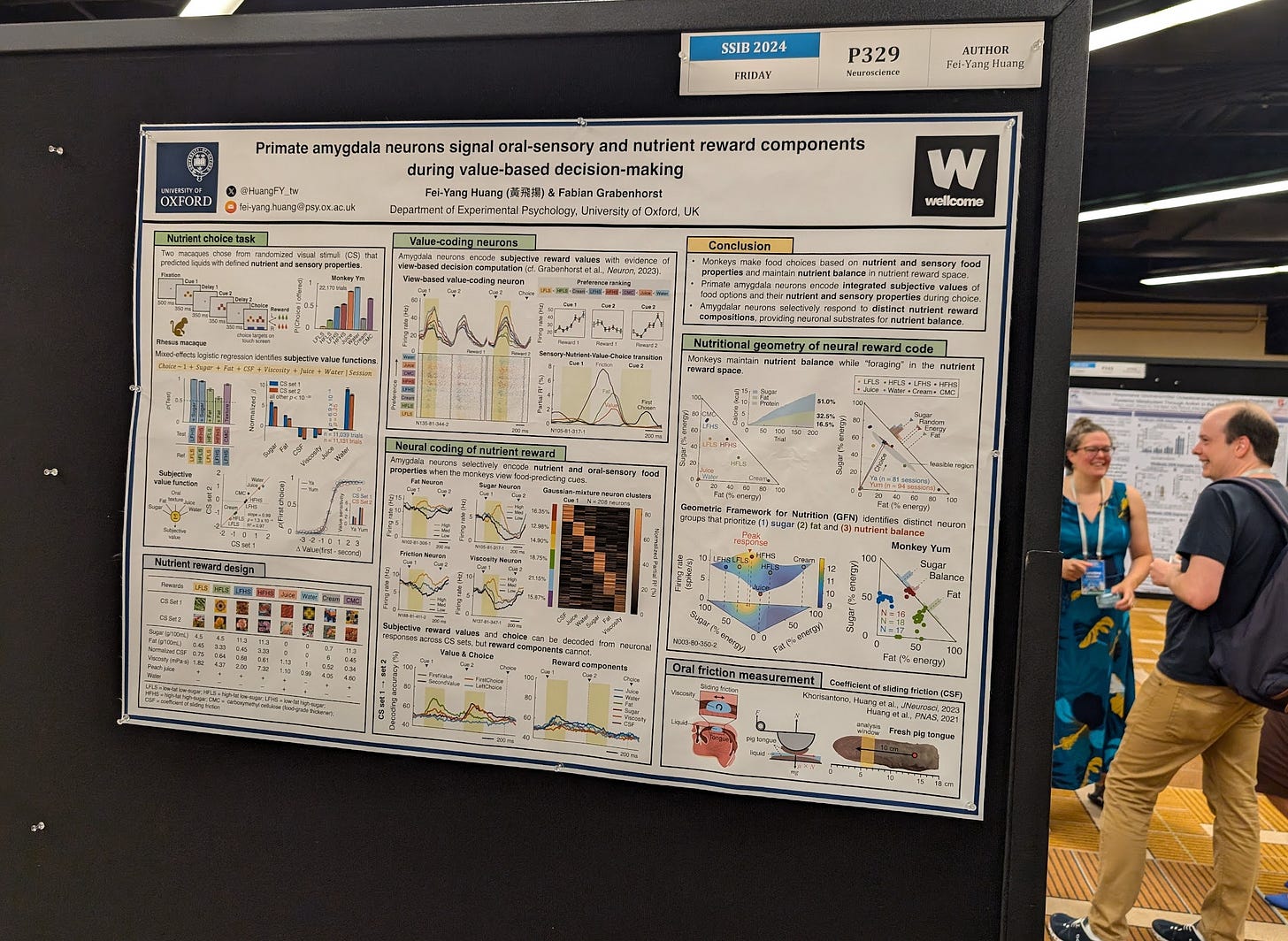
Science permeates everything at SSIB. The hallway chit chat is about science. The talk over dinner is about science. If you sit down at the hotel bar around midnight, you might find yourself sitting next to Lex, a neuroscientist from Washington University, who tells you that laboratory mice are so inbred that they are genetically closer to one another than siblings, but that for reasons no one knows some gain weight during experiments and some don’t.
By every other measure, however, SSIB is dwarfed by the food technologist get-together. Whereas IFT:First boasts well over a thousand exhibitors, SSIB has eleven. About 350 scientists attend SSIB while sixteen thousand people visit IFT:First. It costs about $160,000 to run SSIB. IFT:First brings in more than $22 million in revenue. Financially speaking, IFT:First is 138 times bigger.
The numbers are eye popping, but they shouldn’t be. The ultraprocessed food industry is worth in excess of $150 billion annually USA. That is more than triple the annual budget of the National Institutes of Health—the major funder of scientific research in North America—which spends just a small fraction of that budget on ingestive behaviour.
All of which begs an obvious question: Does the staggering difference in size between these two meetings help explain why, as a species, we are so much more successful at getting people to eat food than not eat food?
The answer might be no. Despite those untold billions of dollars being spent on phosphates, flavorings, sweeteners, surfactants, anti-caking agents and gums, it all may have nothing to do with obesity, diabetes, heart disease, kidney disease and all the rest of it.
This is what is known as the null hypothesis. You must be open to the possibility that the thing you think is happening might not be happening. If you are unwilling to consider that, then your thinking is more religious than it is scientific.
But in this particular case, “no” really does seem unlikely, for the simple reason that IFT:First is, at its essence, about food. And the odds that this massively well-funded industry altering seemingly every known property of food is having no effect on how much of that food makes its way into the stomachs of humans and might have some effect on the health of said humans seems, well, slim.
The question, of course, is how do you test it? I know what you’re thinking. You do science. You investigate if people who eat a lot of ultraprocessed foods are in a poorer state of health than those who do not. (They are.) You run randomized controlled trials to test if, say, people tend to eat more ultraprocssed foods than unprocessed foods. (They do.) You probably already know that ultraprocessed foods usually don’t come out looking very good.
But it just isn’t that simple.
If there was a dominant trend at this year’s IFT:First, it was sweeteners. But not just any sweeteners. They had to be “naturally” occurring, and they had to taste convincingly like sugar.
Allulose is one such sweetener. It is a type of sugar that is found in miniscule amounts in foods like figs, maple syrup and wheat. It has one tenth the calories of sugar, hardly any aftertaste, and it doesn’t cause tooth decay or raise insulin. Even better, you can bake with it. It has been called the perfect sweetener.
Is it? The people selling allulose would like you to think so. What do the scientists think? It’s difficult to say, because it’s relatively new on the scene and there are only a small handful of studies so far.
That is not to say the scientists at SSIB are in any way ignoring sweeteners. There were twenty-two posters and talks on sweeteners, sweetness or sweet substances by my count at SSIB, including:
“Brain Stimulation Reward Supports High Discriminability and Stable Responding in Probabilistic Discounting Tasks Relative to Sugar Pellet Reward”
“KCNK13 Channel Mediates Glucose-Sensing and HFD-Induced Activation in Microglia”
“Reward Learning for Sugars with Varying Rates of Absorption and Utilization”
“Contributions of Prolactin-Releasing Peptide (PrRP) in Catecholaminergic Neurons to Fasting-Induced Feeding, Sweet Tastant Preference, and Affective Behaviors”
“Resting-State Connectivity Between the Salience Network and Left Thalamus in Adolescents Predicts Sugar-Sweetened Beverage Intake a Year Later”
If you delve into what scientists refer to as “the literature,” there are thousands more studies on sweetness. An uncountable multitude are specifically on low-calorie and no-calorie sweeteners, which are often called artificial sweeteners. These substances have been under the metaphorical microscope for decades.
To simplify enormously, some of the research suggests low-calorie sweeteners may be healthy and some suggests they may not be. Every month or two there is a new headline—good, bad, good, bad, and so on, like never-ending tennis match. Not long after the SSIB and IFT:First meetings, a study came out showing that the low-calorie sweetener erythritol causes blood clots. But it was a small study. Which is to say, there will be many more studies on erythritol. And then we might finally have the time and money to take a good hard look at allulose.
But here is the issue: allulose was just one sweetener IFT:First . There was also monk fruit. There was stevia. And not just plain old stevia but all the different sub-compounds found in stevia: stevia Reb. A, stevia Reb B., stevia Reb D., and stevia Reb. M. Nutralong, a company based in Quingdao, China, that sells “sweetener solutions with pure bliss in every sip” offers them in blends: allulose + monk fruit; allulose + monk fruit + reb M.; allulose/erythritol + high intensity sweeteners.
Lesweet, the “pioneer of China’s health & sugar reduction initiative,” was selling low calorie tomato sauce, vinaigrette sauce, roasted sesame dressing, baking icing sugar, canned sugar, and more than seventy-five syrups, all packing a low-calorie punch. The company’s stable of partners include Walmart, 7-11, Nestle, and Tim Horton’s.
An upbeat rep of the California-based company called Sweegen was telling one and all about Brazzein, a new additive that just might be even more dazzlingly perfect than allulose. It is 500-2000 times sweeter than regular sugar, has no calories, and retains its structure no matter the ph level or heat (a big deal, apparently). But wait! It also stimulates the umami taste receptor, which “amplifies flavor expression” and achieves “a greater level of sweet intensity than with natural, non-caloric sweeteners alone.”
Nutralong, Lesweet and Sweegen are just three of the companies in the “sweeteners and sugars” category at IFT. There were 160 more. And that’s just one category.
Over at the Mitsubishi exhibit—yes, the company whose new Outlander SUV boasts third-row seating for seven also has a life sciences division—two Japanese men were dabbing a yellowish Cheese Whiz-like substance on tortilla chips. It was yeast extract, which is an umami booster. You find it in things like potato chips or savoury broths.
Well, that’s what I used to think. Yeast extract, I discovered, is not a single substance. It’s more like a genus. I was handed a tortilla chip dabbed with Ajitop, a “front taste modulator,” that started out savoury and eased off. Then came Aromild, a “flavor balancer” that began gently and built to a long finish. They both tasted like bad fake cheese. Other members of Mitsubishi’s yeast extract family include Ajirex, Aromaway, Komi and Cook-Up.
A Columbian company called Levapan has created yeast extracts that go well beyond umami. The oddly named Plus Wall 20 acts as both a binding agent and, amazingly, a sugar substitute. Plus Wall 30 “improves mouthfeel and creamy notes.” Savoury, sweet and creamy. Yeast can do it all.
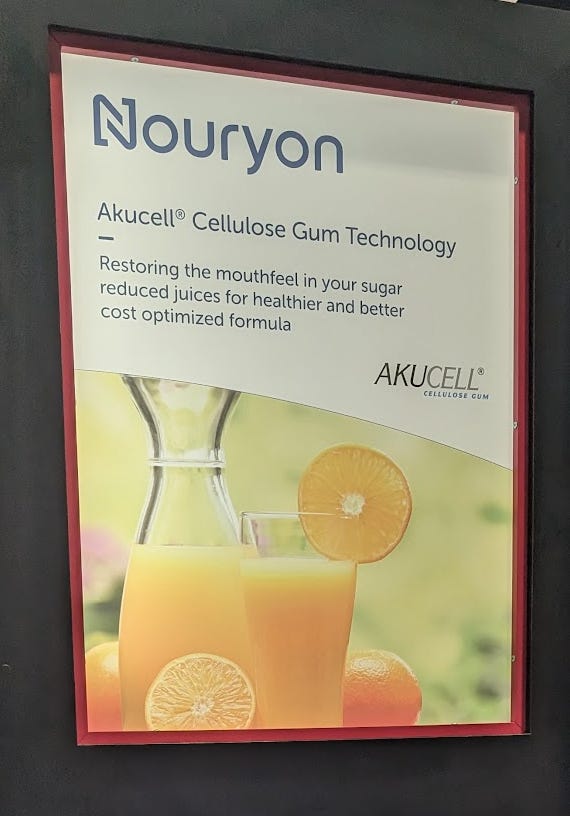
There were also gums. Lots of gums. Nouryon was promoting its Akucell line of cellulose gums. AF 3265 “improves texture and mouthfeel of noodles while reducing oil uptake.” AF 3275, on the other hand, is recommended for yogurt drinks and buttermilk. And AF 2085 should be considered “for use in smoothies and shakes.”
The Fufeng corporation of Quingdao, China, meanwhile, boasted an impressive list of xanthan gums. Suggested applications include: mayonnaise, drinks, dairy products, pickled foods, meat, soft drinks, fruit juice, toothpaste, shampoo, cosmetics, oil drilling, oil recovery, pesticide, polishing agent, adhesive, paint, fertilizer and tobacco.
It never stops. Caldic’s Trusol line of blends “enhances product attributes related to appearance, texture, shelf life & stability, label needs, cost and process efficiencies.” ClonBio’s barley protein concentrate is a “functional alternative for the fast growing food industry protein demand.” 5 Log Reduction, which sounds like a laxative, offers customized food testing services.
I could go on. And on.
Why do we think there is something wrong with these food additives? Just because a substance that increases the viscosity of soft drinks can also be used as a “mobility control agent” when drilling for oil doesn’t make it, by definition, poisonous.
I found one answer, by sheer chance, over at Springer’s little food tech library, where I randomly flipped to page 93 of Flavor-Associated Applications in Health and Wellness Food Products. High temperatures, pasteurization and pressing, it said, reduce the anthocyanin and polyphenol content of strawberries. Anthocyanins and polyphenols are plant compounds, many of which are believed to have favourable health attributes.
This is one of the standard issues with food processing. It has a dumbing down effect. When you handle and manipulate food excessively it starts to become a kind of empty, cartoon version of nature’s original.
It gets worse. While the biochemical diversity of the food we eat diminishes, we toss in all sorts of human-made chemicals. There is nothing wrong with chemicals per se. Everything is a chemical. Vitamins, protein, minerals, antioxidants, endorphins—all chemicals. But these newfangled ones we keep adding to food may have unforeseen results when people eat them. If they alter food, which was living before it was dead, is it so unreasonable to think they might alter us, given that we are living and hope not to be dead?
For example, does the oil-uptake-reducing properties of AF 3265 reduce the calories in a dish of fried noodles? What is its effect, if any, on the microbiome? What about AF 3275? Will Ajitop make people eat more nachos? Could they provoke an immune response because our white blood cells have never encountered them before?
Do all these low-calorie sweeteners confuse our innate energy balancing system? Do newcomers like Brazzein and Allulose just make things worse or better? How about the fat replacers that reduce the calories in salad dressings, spreads and mayonnaise?
Or maybe the problem is that all these starches, protein concentrates, gums, fibres, emulsifiers and anti-caking agents that, by design, have no flavour surreptitiously sneak calories into the gut?
We think of ultraprocessed foods a market segment. But it is more like its own universe. Like our own universe, it is expanding at light speed in every direction.
How can science possibly keep up? No, really. How? Because never mind that after decades of studying fake sweeteners the jury is still out, science has another problem: there is still so much it does not understand about how food interacts with the body.
A case in point: At 8:30am on the final day at SSIB, Valerie Darcey, a neuroscientist at the National Institutes of Health, kicked off the morning session with a talk entitled “Lack of Brain Dopamine Response to an Ultra-Processed Milkshake High in Fat and Sugar in Humans.” For the study, Darcey and her colleagues fed fifty young and healthy subjects a sweet and fatty milkshake and then scanned a part of the brain called the striatum for a surge in dopamine. Numerous other studies had measured just such a surge in the striatum, which is a key part of the brain’s reward centre. Dopamine release in the striatum is noteworthy because it also takes place when people use highly addictive drugs, like heroin and cocaine. When people talk of food having addictive qualities, it is in part because of the dopamine surge in the striatum.
But with Darcey’s subjects, that expected surge in dopamine didn’t appear, which is what made this presentation worth getting up early for. Previous findings were not being replicated. But that might be because this study, according to its critics, was flawed. All of which is to say there will be more research. And it will all take a lot of time.
Speaking of dopamine, everyone thinks of it as the “pleasure” neurotransmitter. Our smartphones, we are told, dole out little hits of it. This is not how scientists see things. Dopamine is about motivation. The neurotransmitters involved in pleasure trigger opioid receptors.
Daniel Castro is a neuroscientist at Washington University who specializes in opioids. Besides the reward system, Castro says, opioids are also found in the septum, hypothalamus, brain stem, spinal cord, stomach, intestines, pancreas, and liver. There are four known opioid receptors, which accept opioid neurotransmitters the way a lock accepts a key. There are also, as you might expect, four opioids that fit into those receptors. Except it’s not quite that simple because they get turned into very large molecules that are then turned into what are called vesicles that get chopped up into the specific little chemical keys that fit into the receptors. It is, like so much of neuroscience biology, brutally complicated.
Dopamine and opioids are two kinds of neurotransmitters. You may have also heard of serotonin, norepinephrine, acetylcholine, GABA and glutamate. There are hundreds, Castro says, if not thousands.
Are you getting the picture? Ingestive behaviour is also its own universe. And it’s also exploding. Every answer leads to five new questions. And a hundred more after that.
All of which brings me back to The Tortoise and the Hare. Food technology really is like the hare. It is in a full-tilt, dazzling sprint, propelled by the gushing profits of the market. But science is not a tortoise, even though it often seems that way. Science is like the runner in Zeno’s famous paradox. No matter how many steps it takes, an infinite number more keep appearing in front of it.
As a I took my last steps at IFT:First, fatigue was setting in. My feet were sore, my lower back was getting tight and my brain was dissolving into fog. I skirted the outer edge of the poster area, blew through the organic pavilion, and didn’t take in so much as a single fireside chat.
I imagined a “consumer”—a mother in a supermarket, say—lifting a packaged food item off a shelf to see what it’s made of. We think of the ingredient panel as the lone patch of truth, there in plain black and white for all to see. That isn’t false, exactly. But I think it’s a sort of deception nonetheless. Who could read its spare, technical words and possibly imagine the enormous yet hidden ecosystem of companies that engineer the substances we put in our mouths.
We talk about “the food environment.” We refer offhandedly to “ultraprocessed foods” and in our heads we picture potato chips and sugary drinks, and we think we know just what we are dealing with.
We have no idea. It’s like dark matter or quantum entanglement. The words are easy enough to say. But does anyone understand the raging complexity that stands behind those words? Can the entirety of it all be captured in by a single human brain, or even a room full of human brains?
As I made my way to the exit, I found myself passing an exhibit with a blue backdrop, perhaps the four hundredth I’d seen that day. There was a man sitting on a foldable chair, shirt untucked, holding his smartphone to his ear as he tried, with great effort, to listen to something over the crushing din. The signage behind him listed the following:
DL-Malic Acid
Fumaric Acid
L-aspartic Acid
Succinic Acid
PBS (Poly Buthylene Succinate)
Acetylacetone
Another roster of agents that do lord knows what to food and might do something to our bodies, brains or our children but, then again, might not. Another galaxy to get lost in. I motioned the man over, gestured at the list of chemicals behind him and asked, “What do they do?”
“I think it’s ingredients they put in food or something,” he said, then sat back down and put his phone back to his ear.
I couldn’t have put it better myself.
***
Mark Schatzker is the Writer in Residence and Associate Director of Communications at the Modern Diet and Physiology Research Centre (MDPRC), McGill University.
Follow me on X and Instagram: @MarkSchatzker